The Offer Is Not the Finish Line (It’s the Negotiation Phase)
When the offer finally lands in your inbox, it feels like relief. Validation. Proof that the months of interviews, rejection emails, and quiet self-doubt weren’t for nothing.
It’s tempting to think you’ve crossed the finish line.
But the truth is, the offer isn’t the end of the process. It’s the beginning of the most important phase: negotiation.
And negotiation isn’t just about money. It’s about making sure the job you’re accepting actually works for your life.
The Emotional Trap of the Offer
After a layoff, offers hit differently. There’s gratitude, urgency, and a strong desire not to rock the boat. You don’t want to jeopardize something you worked so hard to get. That emotional state makes it easy to focus narrowly on salary and miss bigger issues that will matter every single week once you start.
Of course you should negotiate compensation. Base salary, signing bonus, equity where applicable. Companies expect those conversations, especially at senior levels. Avoiding them rarely earns goodwill and often creates regret later.
But money is the easiest part of the negotiation. It’s also the least interesting.
What You Should Be Paying Attention To
Once the initial excitement fades, more important questions start to surface. How will this role actually operate day to day? What does success look like in the first six months? How much authority comes with the responsibility? And just as importantly, how does this job fit into your life outside of work?
These questions matter more than people admit, especially in cybersecurity leadership roles where expectations are high, timelines are compressed, and the margin for error is thin.
My Offer: Right Role, Complicated Reality
In my case, the role itself was exactly what I was looking for. It directly leveraged my experience and represented a meaningful next step professionally. On paper, it was a clear yes.
In reality, it was more complicated.
The job required relocating my family. It was the middle of the school year. And the initial expectation was that I would be onsite four days a week, starting in two weeks.
None of those things are unreasonable on their own. Together, they created real friction. This is where the negotiation stopped being theoretical and became deeply personal.
Negotiating for Life, Not Just Compensation
I did negotiate salary and signing bonus. That part matters, and it should. But it wasn’t the hardest conversation.
The most important thing I negotiated was time and flexibility.
I asked for a temporary hybrid arrangement: one week onsite and one week remote, until my family could relocate this summer between school years. This wasn’t about avoiding responsibility or easing into the role. It was about doing the job well without creating unnecessary disruption at home.
What mattered most wasn’t just the outcome, but how the company responded. They listened. They understood the trade-offs. And they agreed.
That response told me more about the culture than any interview answer ever could.
Why This Part of the Process Is So Revealing
Negotiation reveals alignment. Not just on compensation, but on trust, empathy, and how an organization handles real-world constraints.
When a company is willing to work through a reasonable, time-bound request and put it in writing, it signals maturity. It shows they value long-term success over short-term rigidity. When they can’t, or won’t, that’s information too.
The goal of negotiation isn’t to win. It’s to start the relationship with clarity and mutual respect.
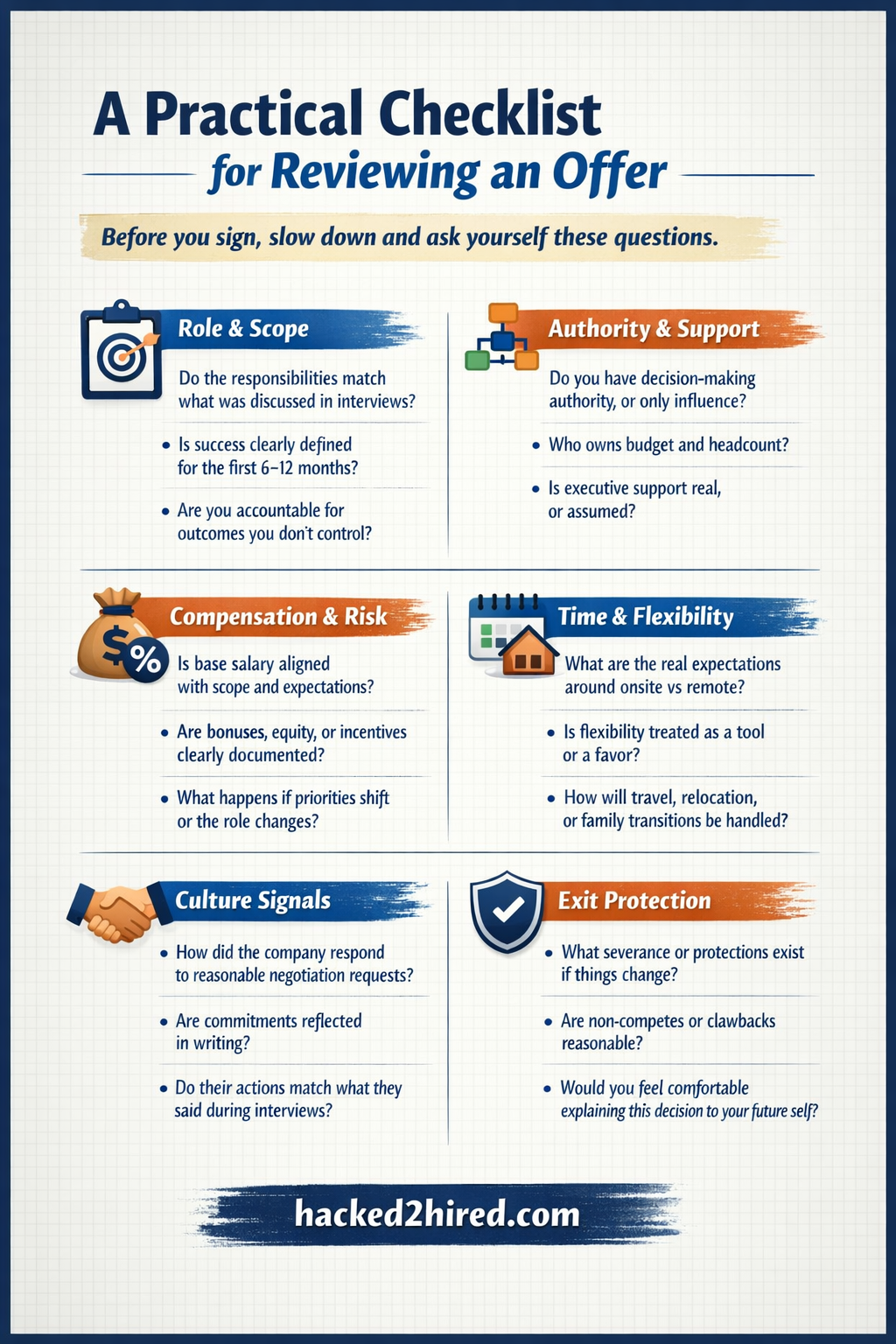
A Practical Checklist for Reviewing an Offer
Before you sign, slow down and work through these questions. You don’t need perfect answers, but you do need honest ones.
Role & Scope
Do the responsibilities match what was discussed in interviews?
Is success clearly defined for the first 6–12 months?
Are you accountable for outcomes you don’t control?
Authority & Support
Do you have decision-making authority, or only influence?
Who owns budget and headcount?
Is executive support real, or assumed?
Compensation & Risk
Is base salary aligned with scope and expectations?
Are bonuses, equity, or incentives clearly documented?
What happens if priorities shift or the role changes?
Time & Flexibility
What are the real expectations around onsite vs remote?
Is flexibility treated as a tool or a favor?
How will travel, relocation, or family transitions be handled?
Culture Signals
How did the company respond to reasonable negotiation requests?
Are commitments reflected in writing?
Do their actions match what they said during interviews?
Exit Protection
What severance or protections exist if things change?
Are non-competes or clawbacks reasonable?
Would you feel comfortable explaining this decision to your future self?
The Offer You Accept Becomes the Job You Get
Every term you agree to sets a baseline. It shapes how boundaries are respected, how problems are solved, and how much trust exists on day one. The way a company negotiates is often the way they lead.
That’s why slowing down at the offer stage matters so much. This is your chance to align expectations before momentum takes over.
Final Thought
Getting an offer feels like winning. But accepting the right offer requires intention. It means negotiating not just for compensation, but for the conditions that allow you to show up at your best.
Careers are long. Families matter. Timing matters.
The finish line isn’t the offer letter. It’s starting the job with clarity, alignment, and no quiet regrets.